Construction
Where Construction Debris Actually Goes Around Longview
Longview is unusual in that the city will collect construction debris — for a fee. Here is when that makes sense, and where the material actually ends up.
The city will take it, for a fee
Most cities refuse construction and demolition waste outright at the curb. Longview does not, and that is worth knowing before you assume a container is the only option.
For a genuinely small job — one bathroom, a single room of flooring — that may be the cheaper route, particularly if you can also use one of your four annual bulky item collections for the non-construction part.
Where a container wins is on anything that is not small: a full renovation, a re-roof, a demolition, or any job where you need the debris gone as you generate it rather than staged at the curb waiting for a scheduled pickup. And of course all of it only applies inside the city — White Oak, Lakeport, Kilgore and the county have their own arrangements.
The Pine Hill Landfill
Pine Hill, operated by Republic Services, is where most of this region's waste ends up, and it is worth knowing its rules whether you are hauling yourself or just want to understand your invoice.
City of Longview residents with sanitation service receive a discount — contact Republic Services for the current amount. It does not apply to commercial waste, so a contractor cannot use a homeowner's discount.
What Pine Hill will not take:
- Tyres, unless split, quartered or shredded
- Oil and oil filters
- Lead acid batteries
- Refrigerators, A/C units and any CFC-containing appliance, unless the refrigerant has been removed by a certified person and the certification letter accompanies the unit
If you want the paper trail on a particular job, ask for the weight ticket. Any hauler running licensed disposal can produce one.
The tarping law
This one is not a facility rule, it is state law, and it catches out more self-haulers than anything else.
An open trailer of drywall offcuts blowing down Loop 281 is exactly what the rule exists to prevent. If you are hauling your own debris, you need a tarp and you need it secured.
It also explains a rule of ours that people sometimes think is arbitrary: the load has to stay below the container rail. Not because we are fussy, but because a container heaped above the rail physically cannot be tarped, and an untarped load cannot legally leave your property. If the can is full, call for a swap rather than building a mound.
Why stream separation saves money
Disposal is priced per ton and the rate varies by stream. Mixed construction and demolition debris is the most expensive category, because the facility has to handle an unpredictable mixture. Clean inert material is cheaper. Clean vegetation goes to compost rather than landfill. Scrap metal has positive value.
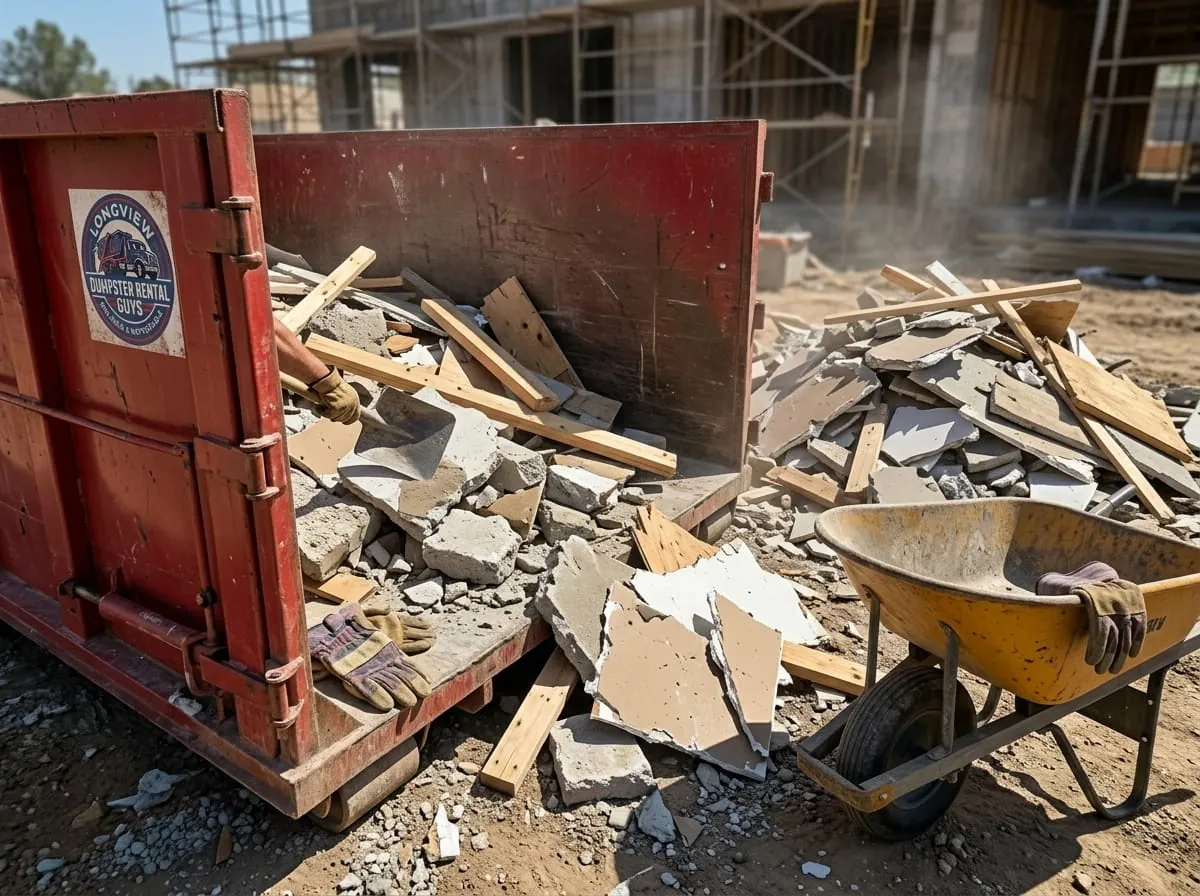
Consider a demolition producing eight tons of broken concrete and eight tons of mixed debris. All in one container and you have sixteen tons at the mixed rate. Split it and eight of those tons move to a cheaper stream. Even after paying for a second container movement, the split usually wins.
The break-even: if you have enough of a clean stream to substantially fill a dedicated container, separate it. A wheelbarrow load, do not bother.
The five streams worth separating
1. Clean concrete, block and masonry
Rebar is generally fine. Timber, plastic sheeting, soil and general debris are not. Goes in a 10 yard because of weight, always.
2. Scrap metal
Copper pipe, steel studs, ductwork, conduit, rebar offcuts and appliances. Out in the county, barn roofing sheet, gates and old implements. On a farm demolition the metal alone is often worth setting aside.
3. Clean dimensional lumber
Untreated, unpainted, fasteners removed where practical. Treated timber does not qualify, which matters here because deck and fence timber is nearly always treated.
4. Cardboard and packaging
New construction generates an extraordinary amount — appliance boxes, fixture packaging, banding, shrink wrap.
5. Clean vegetation
Site clearing, and in the Piney Woods that means volume. Keep it genuinely clean and it goes to the compost route rather than the landfill one. Soil is what usually ruins a vegetation load's economics, so shake the roots out where you can.
Asbestos and pre-1980 buildings
This matters more here than in a newer market, because a great deal of the building stock across Kilgore, Gladewater and older Longview dates from the oil boom decades — the 1930s and 1940s.
Any building from before roughly 1980 should be treated as asbestos-suspect until it has been surveyed. The usual culprits are floor tile and its mastic, pipe lagging, textured ceiling coatings and some siding products. Disturbing them without a survey is both a health risk and a regulatory one.
Abatement is licensed work with its own disposal route and it never goes in a roll-off container. Get the survey done before demolition starts rather than discovering the problem halfway through a strip-out.
Sizing for construction debris
Framing, drywall, packaging and general build waste: go big. A 30 yard, with swap-outs planned into the programme. Bulky and light, so you fill the volume long before the weight allowance.
Concrete, block, brick, tile and boom-era material: go small. A 10 yard, filled between half and two-thirds.
Most real jobs need both at different phases, which is why we would rather talk through the programme than take a single order.
Practical site setup
- Place containers where the work is, not where they are convenient for the truck. Labour spent walking debris across a site is the largest hidden cost in waste handling.
- Label them. A sheet of plywood marked CONCRETE ONLY prevents a great deal of expensive contamination.
- Brief the trades. One subcontractor throwing a lunch bag into the clean concrete container costs more than the briefing would have.
- Keep it below the rail. It has to be tarpable.
- Book swaps into the programme, not on the day you notice the can is full.
- Watch the ground. East Texas clay holds water. A site access route that carried a loaded truck in August will not necessarily carry one after a wet week in April.
- Cover heavy loads if rain is coming. You pay for that water by the ton.
We are happy to help set that up — tell us the build programme and we will schedule around the trade sequence.
Need a container in Longview?
Call and describe the job. Three minutes on the phone gets you a size recommendation, a flat rate and a delivery window — and we will tell you if a smaller, cheaper container is the right answer.
Call (903) 500-2602