Permits
Do You Need a Permit for a Dumpster in Longview?
The short answer is usually no. The longer answer involves a lot of separate small cities, four counties, and a service area where the rules change every few miles.
The short answer
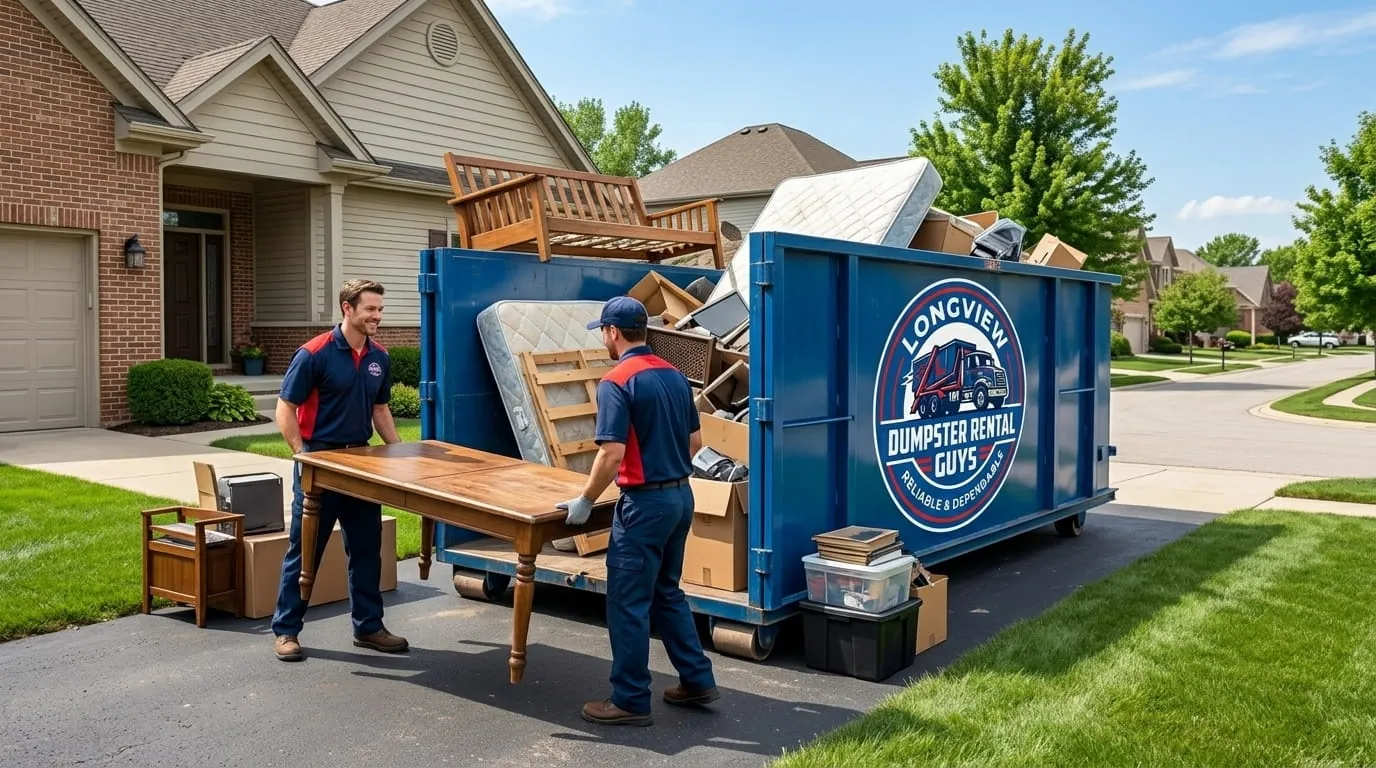
If your dumpster is going on your own driveway or your own private property, you almost certainly do not need a permit. That covers the overwhelming majority of the containers we place.
If it has to sit on a public street, you will need one — and which office issues it depends entirely on where you are, which in this part of East Texas changes every few miles.
Private property: no permit
A driveway, a private parking area, a fenced construction site, a commercial lot you own or lease — all private property, no municipal permit required for the container itself.
Two caveats that are not permits but function like them. The underlying work may need a permit — roofing, structural demolition, electrical, plumbing, additions and exterior alterations generally do. And deed restrictions, if your property has any, may set their own rules.
Public street: yes, permit
Placing a container in the street means occupying public space, and every jurisdiction we work in regulates that. The permit exists for sensible reasons: emergency access, sight lines at junctions, drainage and night-time visibility.
Our honest advice: if there is any way to get the container onto private property, do that. Street placement is a last resort, and on the narrow older streets in downtown Gladewater, Kilgore or Marshall it is sometimes genuinely the only option — but it needs arranging in advance.
The patchwork problem
Longview itself is straightforward: the city handles its own. But drive ten minutes west and you are in White Oak, which is its own city with its own rules. Ten minutes south and you are in Lakeport, also its own city. Liberty City, by contrast, is unincorporated Gregg County with no municipal permit process at all.
That patchwork is genuinely confusing, and it is a fair question to ask us rather than guess. We work across all of it.
Who to call, depending on where you are
| Where the property is | Who to approach |
|---|---|
| Inside Longview city limits | City of Longview |
| White Oak, Lakeport, Warren City, Clarksville City, Easton | That city |
| Kilgore, Gladewater | That city (both straddle county lines) |
| Unincorporated Gregg County - Liberty City, Judson | Gregg County; no city process |
| Hallsville, Marshall | That city, or Harrison County |
| Henderson, Overton, Tatum | That city, or Rusk County |
| Gilmer, Big Sandy, Ore City, Diana | That city, or Upshur County |
If you are not sure which side of a line you are on, call us with the address. We can usually tell you immediately — and if we cannot, we will say so rather than guess.
City services do not follow you
Worth flagging because it causes more confusion than the permits do.
The City of Longview sanitation services — the four bulky item collections a year, the weekly yard waste pickup, the compost site, the Pine Hill Landfill resident discount — are for City of Longview sanitation customers. They are funded through the city bill.
If your address is in White Oak, Lakeport, Kilgore, Liberty City or unincorporated Gregg County, none of that applies to you. Your own city or county has its own arrangements, and they are not the same. The compost site in particular asks for proof of service — a current city water bill and a matching driver's licence — precisely because it is a customer benefit rather than a public facility.
People move out from Longview a few miles and reasonably assume the services came with them. They did not.
Deed restrictions and rural property
Out in the county there is generally no permit process at all, which sounds simpler and mostly is. Two things still matter.
Deed restrictions exist on plenty of rural subdivisions and lake developments around Lake O' the Pines, Lake Cherokee and Martin Creek. They are private covenants rather than law, but they are enforceable.
Access is the real constraint, not paperwork. Long private drives, gravel surfaces, soft ground after rain, and pine canopy that does not leave the twenty-two feet of clear height we need to raise the truck bed. On rural jobs, that conversation matters far more than any permit question.
What we need from you
- Whether the container is going on private property or the street
- Which city or county the address is in, if you know
- Whether the property has deed restrictions
- The drive surface and length, and whether there are low branches
- Whether the underlying work is permitted, if it needs to be
If street placement turns out to be necessary, we will tell you which office to approach and what they typically ask for. We cannot pull the permit on your behalf — it attaches to the property owner or contractor — but we can make sure you are asking the right authority first time.
Regulations change. Everything above reflects how these authorities operate at the time of writing, but ordinances get amended. For anything consequential, confirm directly with the relevant office before you rely on it.
Need a container in Longview?
Call and describe the job. Three minutes on the phone gets you a size recommendation, a flat rate and a delivery window — and we will tell you if a smaller, cheaper container is the right answer.
Call (903) 500-2602